Showing posts with label nutrition. Show all posts

Monday, October 26, 2015

Favorite Fall harvest Fruits and Veggies


Fall is known as the harvest season because many of our best loved foods are available at farmers' markets and grocery stores at their peak of freshness.  The beautiful orange and yellow colors that we see in the fall are reflected in our favorite foods of the fall season.

Below are some of our most popular fall foods, and ways we like to enjoy them.  Enjoy the fruits and veggies of this season!

Apples: whether you love the sweetness of a Gala, the sweet tart of a Gingergold, or the tartness of a  Granny Smith, apples should all taste amazing this time of year because they are fresh from the tree!  Try them sliced in Apple Cranberry Salad, topped with nut butter and raisins in Apple Bark, or cooked in Baked Apples and Sweet Potatoes.

Broccoli:  a favorite in grocery stores all year long, broccoli is most flavorful in the fall.  This all-purpose veggie is perfect for dipping in hummus, like in our favorite Garden on a Plate recipe.  It tastes delicious broiled with a little low-sodium soy sauce, added to stir fries, and in Broccoli and Potato Soup.

Cabbage:  an often overlooked vegetable, cabbage is a main ingredient in coleslaw mixes and traditional sauerkraut.  Try it shredded in Simple Fish Tacos or cooked in Garden Vegetable Soup, a perfect meal for chilly fall nights.

Cauliflower:  related to both broccoli and cabbage, cauliflower is available in markets in the familiar white variety, as well as orange and purple types,  It can be eaten raw, boiled, steamed, added to stir fries, and cooked and mashed to resemble potatoes.  Roasted Cauliflower is one of our favorite -- and easy -- ways to enjoy this delicious vegetable.

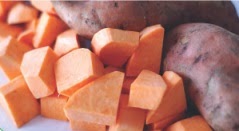
Sweet potatoes:  loved by kids and adults, the sweet potato is a rich and creamy orange vegetable that has a natural sweetness.  Sweet potatoes can be baked or boiled, mashed on their own in Maple Mashed Sweet Potatoes, or added to stews and chili, and even burritos and quesadillas.  Try our easy Sweet Potato Fries recipe tonight.  It's sure to become a family favorite!

Squash: truly a hallmark of fall, different squash varieties are a  feast for your eyes and for your belly.  Markets this time of year will have acorn, butternut, spaghetti, and delicata squash in abundance, along with orange and even blue pumpkins!  Cooking these squash requires a little muscle to cut them in half, however, you can pierce the skin and microwave on high for a few minutes to soften them and make them easier to cut.  There are many different ways to prepare squash.  Enjoy a twist to regular spaghetti squash and meat sauce by using this Spaghetti Squash recipe instead.  Apple Stuffed Acorn Squash is a great way to use more than one fall veggie and apples go great with squash!


Tuesday, June 16, 2015

Favorite Fruits and Veggies to Buy at the Farmers' Market

Image courtesy of Maryland Farmers' Market Association

Farmers' markets are a great way to buy fresh fruits and vegetables.  The fruits and vegetables at a farmers' market are picked right from the plant and taken to the market.  The produce at the farmers' market is always in season.  You can be sure they will be fresh and delicious!  Since there are many fruits and vegetables to buy at the market, it can be hard to know which ones will be the best buy for you and your family.  Here are five favorite foods to buy at the farmers' market.

Tomatoes
There are many shapes and sizes of tomatoes.  All of them can be used in a lot of meals.  Tomatoes from local farms taste better because they are fresh.  Tomatoes also have antioxidants to keep you healthy.  Pair them with zucchini and have a healthy side dish.  Check out the Zucchini and Tomatoes recipe from a previous blog post!

Berries
Strawberries and blueberries are a great summer treat!  They are better to buy at the farmers' market because they are in season and can be grown in Maryland.  Berries have many vitamins and minerals that are good for you, too!  Make them part of your breakfast with a Red Berry Parfait!

Carrots
At the grocery store you will most likely find orange carrots.  At the farmers' market, they come in many different colors and sizes.  Carrots also make the perfect on-the-go snack!  Add carrots to your "Garden on a Plate", which is a great recipe that kids can help to make. 

Onions
Onions can be used in hot meals or raw on a salad.  Onions are great to use to add flavor to your meals. There are a variety of onions with different flavors, shapes, and colors.  Try grilling them to bring out the flavors!

Zucchini
Zucchini is in-season and tastes best in the summer.   It can be used in hot dishes or eaten raw.  Zucchini can be put into salads, soups, and stir-fries.  This is an easy way to add veggies to your meal. 

Ask a farmer if you do not know which fruits or vegetables will be best for you.  Farmers know a lot about the fruits and vegetables they grow and sell, so think of them as the produce experts.  Farmers' markets are a great way to try new fruits and vegetables too.  Next time you are at your local farmers' market, pick something up you have not had before!

To find the local farmers' market near you, visit the Maryland Farmers' Market page.

Monday, April 7, 2014

Less Salt Makes Good Sense

 
Do you consume too much salt?  Using less salt will reduce your chances of developing high blood pressure, a leading cause of heart disease, kidney disease and stroke.  Everyone, including children, should eat less salt each day.

Many foods we enjoy contain a lot of added salt.  Prepared and convenience foods are especially high in salt.  Try these tips to help you cut back on the salt you use every day.
  • Choose fresh foods.  Eat less processed foods like pizza, bacon, hot dogs, lunch meats, and canned soups.  We get most of our salt from these foods. Fresh foods are lower in salt.
  • Cook more often.  Use spices, herbs, garlic, lemon juice or vinegars to season foods instead of salt.  Try the Eat Smart Seasoning Mix to add flavor without adding salt.
  • Read food labels.  Spend a little time and read the Nutrition Facts Label and the ingredient list to find the foods with less salt.  Choose foods labeled "low sodium", "reduced sodium" or "no salt added".
  • Eat more fruits and vegetables.  Fresh or frozen veggies and fruits are naturally low in salt.  To remove the salt from canned veggies, rinse them under cold water.  Make half your plate fruits and veggies at every meal.
  • Choose dairy and protein foods low in salt.  Choose low-fat or fat-free dairy foods but be aware of salt content.  While yogurt is low in salt, cheese has more added salt.  Select fresh cuts of meat and seafood.  Use canned meats, sausage and lunch meats every now and then as they contain more salt.  Buy unsalted nuts and seeds for snacks.
  • Trick your taste buds.  Have a taste for salt?  Cut back on salt little by little, your taste for salt will lessen over time.  You will be able to enjoy the natural flavor of foods, and your family's health will be better for it.
  • Make a change.  Following these tips can be helpful to everyone, but especially adults age 51 and older, African Americans of any age and individuals with high blood pressure, diabetes, or chronic kidney disease.  Eating less than a teaspoon of salt each day is recommended.

Monday, January 20, 2014

Smart Shopping for Fruits and Vegetables

 
Is adding more fruits and vegetables to your family meals one of your New Year's resolutions?  You can add these healthy foods even when you are on a tight budget.  Eating fruits and veggies is important for good health and to reduce your risk of certain diseases.  Follow these low-cost tips to increase the fruits and vegetables that you eat.
  1. Check store sales.   Use your local newspaper or go online to check weekly sales.  Plan your meals and snacks using those fruits and veggies you find on sale.  When possible, buy extra and stock up for later use.
  2. Make a shopping list.  Plan your meals and snacks before going to the grocery store and make a list.  Stick to your list.  You will save money by buying only what you need.  Don't go to the store hungry.  Eat before you go and avoid the inviting snack foods.
  3. Buy fresh fruits and veggies when in season.  This is when their taste is the best and prices are usually lowest.  To learn what is in season in Maryland, click here. The local farmers' markets also have a wide selection of seasonal produce.
  4. Try canned and frozen.  Compare the price and number of servings of the same item found canned, frozen and as fresh produce.  Usually, canned and frozen items are less expensive than fresh.  When buying canned, choose fruit packed in 100% juice, and choose vegegies with "no salt added" or "low sodium" on the label.
  5. You do the work.  Buy whole fruits and veggies and do the washing, chopping, and slicing yourself.  "Prepared" forms of fresh produce are convenient, but usually cost more.
  6. Buy store brands.  Compare your store brand to the national brands.  You will find the similar product for a lower price.  Try several store brands to find your family's favorite.  They are especially good buys for use in soups and stews.
  7. Plant a garden.  Provide your family with fresh fruits and veggies by growing your own.  Gardens are grown in a pot or in your yard.  They are easy and inexpensive ways to add produce to your family's meals and physical activity to their day.  Visit a previous blog post on how to grow your own container garden.
What are some of your ways that you save money when shopping for fruits and veggies?

Monday, January 13, 2014

Food Wants and Needs: There is a Difference!

 
Keeping food costs down can be tough.  We have so many choices to make when shopping for food these days.  Deciding between foods you need and foods you want can help lower food costs.

So, what is the difference between a need and a want?  Think of it this way:  A need is something that we must have to survive; a want is something that will make that survival nicer.  When making meals, we need to decide what our food needs and wants are.  If we are trying to save money, we should look for ways to make healthy meals at home and cut back on eating out or buying foods that are already made (and cost more). 

Foods that are less healthy, and are high in fat and calories, should be "once-in-a-while" foods.  Use MyPlate to plan your family's meals.  Pick lean meats, whole grains, a variety of fruits and vegetables, and low-fat dairy foods.

Once your basic food needs are met and if you have extra food dollars to spend, you can pick some of your food wants. 

Every family has different food needs and wants.  What is a need for one family might not be a need for another.  Your food needs and wants change with time and family situations.  It can be hard to decide.  Make the most of your food dollars.  Pick healthy foods for family meals and snacks!

Monday, December 16, 2013

6 Healthy Winter Habits


During the winter we tend to overeat and spend too much time indoors.  We also go to bed earlier than our normal time and then wake up later due to the long winter nights.  For those cold days, we drink more coffee and tea and not enough water.  Here are 6 healthy habits you can do to stay happy and healthy during the winter months.

  1. Don't hide from the outside -- Get outside each day for some light.  Getting out in the sun helps to keep your spirits up and your weight down.  Some ways to get outside in the winter are:  go for a walk, play in the snow, shovel the driveway and walk ways, decorate your house for the holidays, and play with the pets.
  2. Eat Healthy -- Fruits and vegetables provide essential vitamins and minerals, fiber, and other substances that are important for good health.  Try to incorporate more fruits and vegetables into your diet.  Determine what is in season right now and dig in.  You'll be rewarded with high quality produce, packed with nutrition, at a lower cost.  Plan your food in advance so you are not tempted to buy extra treats at the grocery store.  To find out what is in season in Maryland, visit the Maryland Harvest Calendar.
  3. Stay active -- You can stay active while you keep your home looking good.  Do active housework like sweeping, mopping, vacuuming, doing laundry, or washing the windows.  If you shop, carry your own packages and then unload them in the car after every store. Dance to your favorite music and keep the spirit up.
  4. Drink water -- It may be cold and wet outside, but don't forget to drink plenty of water to keep you hydrated and help you feel healthy.
  5. Handle and prepare food safely -- As you prepare holiday or any of your meals, keep yourself and your family safe from food-related illness.  Keep raw meat, poultry, seafood, and eggs (including their juices) away from ready-to-eat foods like fresh fruits and vegetables, bread, baked goods, cold cut meats and sandwiches, and all eating surfaces.  Do not leave perishable foods out for more than two hours.
  6. Stay warm -- Cold temperatures can cause serious health problems, especially in infants and older adults.  Stay dry and dress warmly with several layers of loose-fitting, tightly woven clothing.
What are some ways you stay healthy during the winter months?

Monday, November 25, 2013

Healthy and Quick Thanksgiving Side Dishes


The holiday season is just around the corner, and along with family and friends comes stress and lots of food.  Try making your Thanksgiving meal simple can help reduce stress and keep your family healthy.  Add a few other healthier options to your Thanksgiving meal this year while still having your traditional comfort foods.  This year, try to pick vegetable side dishes that have fewer ingredients.  This will help to cut down on the cooking time and have fewer calories while still tasting great! 

To avoid extra holiday pounds, load up your plate with vegetable side dishes and eat them first!  By eating your vegetables, you will get nutrient rich foods that will help you feel full.  This may help you avoid the second helping of other higher calorie foods.

Looking for great side dishes to make for your family this year?  Here are a few recipes that you may want to try!

Baked Apples and Sweet Potatoes
Acorn Squash Filled with Savory Spinach
Roasted Vegetables with Maple Glaze
Sweet Potato Casserole

Here are some tips to remember:
  • Fill up your plate with fruit and vegetable side dishes.
  • Choose recipes with fewer ingredients that are easy to prepare and clean up.
  • Add fruit to your meal and skip dessert!
What is your favorite healthy Thanksgiving dish to prepare?


Monday, November 18, 2013

Easy Ways to Enjoy Sweet Potatoes

 
Sweet potatoes are full of fiber and Vitamins A and C.  They are easy to store -- just put them in a
cool, dry place, away from sunlight.  They can be found all year long, but Fall is when you'll find the freshest and cheapest sweet potatoes.  So don't wait!  Now is the best time to include them as a healthy part of family meals!

Some of the great health benefits that come from eating sweet potatoes include:
  • Improved eye sight
  • Strong bones
  • Lower cholesterol
  • Boosts immunity
Sweet potatoes have a slightly sweet but mild taste, so they go well with lots of herbs and spices.  Try them instead of white potatoes and see what your family thinks!

Here are some fun and easy ideas to make sweet potatoes for the whole family:
  1. Healthy Baked Sweet Potato Fries
  2. Mashed Sweet Potatoes
  3. Baked Sweet Potatoes & Apples

Monday, November 11, 2013

Eating Healthy Whole Grains

Barley
What's the difference between whole grains and non-whole grains?  Grains are found in foods like bread, pasta, cereal, rice and oatmeal.  These types of foods are considered whole grain if they have not been milled, which is a process where some important nutrients are removed from the grain.  This process is done to help the food last longer.  To know if the food that you choose is whole grain, look for "100%" or "whole" in front of "wheat" or other grain. 

Whole grains help our bodies in many ways because of the fiber, vitamins and minerals.  These nutrients are important to help reduce the risk of heart disease and some cancers.  Fiber is important to help food to digest and gives the body a feeling that it is full after eating.
Quinoa

The whole grain that contains the most fiber is barley! Barley has more protein than other whole grains.  Barley is used in soups, stews and some cereals.  For recipes to try to add barley into your meals, click  here.

Quinoa is another whole grain, and it contains the most potassium of all other whole grains!  Quinoa can be added to many different dishes or eaten for breakfast.  To learn more about quinoa and ways you can prepare it, check out a previous blog post here

Another type of whole grain is oats.  Oats can be steamed and flattened to help them cook faster.  These oats become softer and are known as quick or instant oats.  Another type of oats is steel-cut oats, which are sliced once or twice into smaller pieces to help water get in to cook.  Steel-cut oats are usually chewy. 

Tips for eating whole grains include:
Steel Cut Oats
  • Eating whole grain cereals
  • Changing white rice to brown rice
  • Choose whole grain spaghetti
  • Eating popcorn for a snack
For more information and tips on eating whole grains, visit Choose MyPlate

What is your favorite whole grain that you like to prepare?


Monday, November 4, 2013

It's Pumpkin Season!

During the fall, pumpkins can be found everywhere!  Did you know that pumpkins can be used for many more things than just a decoration or for carving during Halloween?  Fall is a great time to enjoy this in-season fruit.  Pumpkins are a great source of potassium and Vitamins A and C.

How to Select:
For cooking or baking, try to choose smaller sized pumpkins, which have a more flavorful and tender flesh.  Look for a dull surface, because a shiny skin may mean the pumpkin was picked too soon.  Make sure the pumpkin still has a stem!

If you want to avoid the mess of cutting and scooping out the seeds and flesh of a while pumpkin, try buying 100% pure pumpkin puree, which comes in a can or box.

Ways to Enjoy Pumpkin:
  • Cut pumpkin flesh into cube-sized pieces and roast in the oven.  Toss on our favorite salad!
  • Drizzle pumpkin seeds with olive oil in the oven for 30-45 minutes at 350 degrees F.  You can even spice them up with some cinnamon or garlic powder.
  • Layer pumpkin puree with low-fat yogurt and your favorite toppings to make a pumpkin parfait.
  • You can also try this kid-friendly pumpkin pie dip recipe below.


Pumpkin Pie Dip

Ingredients
15 ounce can 100% pure pumpkin
3/4 cup brown sugar
1 teaspoon vanilla
1/8 teaspoon cinnamon
1/8 teaspoon pumpkin pie spice
6 ounces fat-free yogurt

Directions
1. Mix together all ingredients in a bowl and blend well.
2.  Chill in the refrigerator until ready to eat.  Serve with apple slices!

Monday, October 21, 2013

Bushels of Fun

 
When you think of fall, does the scent of apples come to mind?  How about the sound of an apple being plucked off of a tree?  If it does then you will like going to an apple orchard where you can pick your own apples!  The pleasure of harvesting your own fruit is great!  Picking a bright red, green, or yellow apple, taking a big bite, and enjoying every juicy, sweet taste is exciting.  Apples are packed with lots of nutrients.  Try finding a local orchard near you! Visit this link to find one that is close:  http://pickyourown.org/MDbalt.htm 

You can add apples to a lot of your favorite foods.
  1. Chop apple slices to top your salad.
  2. Try using apples in your coleslaw.
  3. Bake apple slices to make apple chips.
  4. Make your own applesauce.
  5. Add chopped apples to your chicken salad sandwich.
To satisfy your sweet tooth, try this healthy-er dessert!

Apple Crisp
Serves 8

Ingredients
4 apples (medium)
1/4 cup oatmeal (quick cooking)
1/4 cup whole-wheat flour
1/2 cup brown sugar
1 Tbsp. cinnamon
1/4 cup margarine

Instructions
1.  Preheat oven to 350 degrees F.
2.  Grease the bottom and sides of a square 9 x 9 baking pan.
3.  Remove the cores from the apples.  Slice the apples.
4.  Spread the sliced apples on the bottom of the pan.
5.  Cut the margarine into small pieces and put in a medium-sized bowl.
6.  Add the oatmeal, flour, brown sugar, and cinnamon.
7.  Using two knives, cut the margarine into the mixture until it looks like small crumbs.
8.  Sprinkle the mixture over the top of the apples.
9.  Bake in the oven for about 20 minutes.

Monday, October 14, 2013

Quinoa -- A Healthy Whole Grain

Quinoa pronounced (keen-wa) is an ancient grain but it's also a very popular grain right now.  Quinoa is a small whole grain similar to couscous and rice but it is packed with protein and fiber to keep you feeling full and satisfied.  Quinoa has a nutty flavor and can be cooked in many different ways! Try including quinoa to make half your grains whole grain!

How to prepare quinoa:
  1. Rinse -- quinoa contains a bitter coat that needs to be washed off before eating.  Most of the time when you buy quinoa it is already cleaned but it is a good idea to do a quick rinsing before you cook it.
  2. Boil -- follow the package directions and boil quinoa with water in a medium pot.
  3. Simmer -- once the quinoa is brought to a boil, cover the pot and reduce heat to low.  Allow the quinoa to simmer on low for 15-20 minutes.
  4. Fluff -- give the quinoa a good fluff with a fork before serving.  This will improve the taste and consistency!
Ways to eat quinoa:

Quinoa has a nutty flavor that will go well with many different ingredients.  Here are some favorite ways to eat quinoa:
  1. As a warm breakfast cereal topped with honey, cinnamon, and blueberries.
  2. In a salad with chickpeas, cucumbers, onions, tomatoes, and vinaigrette
  3. In a burrito with black beans, avocado, and tomatoes.
  4. As a side dish with chicken, turkey, lean meat or fish.

Monday, September 30, 2013

Let Your Child Be the Chef

Does your child like to help you in the kitchen?  When young children get to help prepare foods in the kitchen they learn to try new foods.  Getting your children involved in the kitchen can be rewarding for you too.  It is a great way to make meals and memories together.

 Why cook with young children?

  • Kids love to eat foods that they have helped to make.  It is a great way to encourage your child to eat fruits and vegetables.
  • Kids feel good about doing something so "grown up".  Keep the tasks small and praise them for helping. 
  • Kids love helping in the kitchen.  Take the time to teach them how to follow instructions, count, measure and stir.
  • Cooking together means more time together with your children. this is great on busy days.

What can young children do?
  • Tear lettuce for a salad.
  • Scrub and clean vegetables such as potatoes and carrots.
  • Set the tablet with napkins, place mats, dishes and utensils.
  • Stir together ingredients.
  • Help make sandwiches.
  • Pick which vegetables to go into a salad and soup.

Safety reminders
  • Remember to wash hands before you start cooking.
  • Use back burners on the stove when possible.
  • Turn pan handles toward the back of the stove and counter so children cannot grab them.
  • Never leave a child alone in the kitchen when the stove and oven are on.
  • Teach young children that they should not touch the oven or stove. Never ask a young child to put anything in the oven or remove anything from the oven.

Check out the video below from Nutrition.gov  for more ways that kids can help in the kitchen. 


Monday, September 23, 2013

Focus on Family Meals


What a great way to start the school year off by trying to include family meals in your day.  Family meals help to bring the family together to talk about their day and build lasting relationships.  Family meals can be any meal of the day -- breakfast, lunch or dinner.  Here are a few tips that may help you to plan family meals together!

  1.  Get the whole family involved.  Kids love to help in the kitchen so try to include them in preparing dinner.  Kids can help wash fruits and veggies, tear lettuce for a salad, set the table or choose a veggie to eat!
  2. Family meals can be quick and simple.  They do not have to be a huge meal, it can be as simple as having a sandwich or tossed salad, your favorite fruit and a glass of milk.
  3. Family members are the best role models for children.  Always include fruits and veggies at your table and encourage your children to try them.  When children see you eating fruits and veggies, they are more likely to try them too.
  4. Plan meals ahead of time.  Start planning your meals and do the grocery shopping on the weekends.  Write on a calendar what you plan to have for dinner each night.  This will cut down on the time you would spend deciding what to eat when you get home.
  5. Turn the T.V. and other electronic devices off.  Do not answer phone calls so that you can focus on your family.  Ask your kids how their day went and if they learned something new.
Family meals can be a great way to spend with your family.  Make a goal to plan a family meal at least once a week.  Tell us some of your ideas for planning family meals!

Monday, September 16, 2013

Start Every Day with Breakfast!

 
Choose healthy foods from each food group to:
  • Help children do better in school.
  • Give you energy to stay active.
  • Give you nutrients to stay healthy.

No time to make breakfast? Try one of these breakfast ideas for a quick meal on the run.
  • Whole grain tortilla with banana and peanut butter
  • Yogurt with dry whole-grain cereal on top
  • Trail mix with cereal, nuts, and raisins in a snack bag and a glass of low-fat milk
  • Scrambled egg with low-fat cheese on a whole grain bagel
  • Oatmeal in a cup with dried fruit and nuts on top
  • Fruit smoothie blended with low-fat yogurt or milk
This quick and easy smoothie recipe make a great breakfast-on-the-go.  It is also perfect for after-school snacks.

Breakfast Smoothie

Serves 1

Ingredients
1/2 cup low-fat milk (1% or fat free)
3-5 frozen strawberries
1/2 banana
Ice Cubes

Directions
1.  Place the milk, strawberries, and half a banana in a blender.  Blend for 30 seconds.
2.  Enjoy your drink with a whole wheat bagel.  You can choose any combination of your favorite fresh or frozen fruits or 100% fruit juice.

Monday, September 9, 2013

Make Back to School Lunches with Safety in Mind

If your children enjoy bringing their lunches to school, follow these simple ways to be sure that foods brought from home are safe to eat.

  1. You'll Need a Few Basic Items.  Invest in some basic tools for keeping foods safe.  Look for sales on insulated lunch bags or lunch boxes, insulated containers for keeping foods hot, and gel freezer packs to keep foods cold.
  2. Clean, Clean, Clean!  Before you start preparing lunches-to-go, wash your hands with warm, soapy water for at least 20 seconds.  Wash cutting boards, dishes, utensils, and countertops, too.  Keep family pets away from the food preparation area.
  3. No Contamination, Please!  Bacteria can spread to counters, cutting boards, and utensils.  Use one cutting board for meat and chicken, and another cutting board for fresh produce.
  4. Keep Cold Foods Cold!  Perishable foods (foods that need to be kept cold) include meat, chicken, and eggs.  Use two cold sources -- either two frozen gel packs or one frozen gel pack and a frozen beverage.  Place the cold sources under and above perishable foods to keep them cold.  If you pack lunches in the evening for the next day, store foods separately in the refrigerator and pack lunch bags in the morning.  Or keep packed lunches with the lid open in the refrigerator until your children leave for school.
  5. Keep Hot Foods Hot!  Fill insulated containers with boiling water and let stand for a few minutes.  Empty the water and then add the heated food.  Insulated containers are great for keeping foods like soup and chili hot.
  6. Lunchtime Cleanup.  Teach your children to throw away any leftovers and food packaging after lunch.
Even young children can help with making and packing lunches.  Find appropriate tasks that each child can do successfully.  Working together provides an opportunity for you to help your children develop cooking skills and learn safe food preparation practices.

For more information about food safety, visit: 
www.foodsafety.gov
www.fightbac.org/safe-food-handling/safety-in-all-seasons/129-bac-to-school-pack-a-safe-lunch-101

Monday, August 19, 2013

Picky Eater or Just Learning to Try New Foods?

 
If your child refuses to eat certain foods or does not want to taste something new, they're not alone!  Children don't always like new foods right away.  They might need your help in learning to like new foods.  Here's how!
  • Be a good role model.  Do you enjoy fruits and veggies or other healthy foods?  Include them in your meals and show your children how much you like them!  Talk about what you like -- the taste or the texture or even the color!
  • Be patient.  Remember that your child might need to try a new food up to 15 times before they like it and eat it every time you give it to them.
  • Keep trying!  Give your child small amounts of fruits and vegetables even if they do not eat them at first.  Offer your children small amounts of new foods so that you do not waste food.
  • Try making the new food in different ways.  Make up a silly name for the new food or sing a little song about it; your child is more likely to be curious and try it!
  • Pair a new food with a favorite food.  Serve a new fruit or veggie as a snack when your child is hungry.
  • Give children small amounts to taste or play with at first.  This can be as small as a spoonful of peas or cooked carrots, a piece of an apple, or one section of an orange.
Children love to help in the kitchen, so include them when preparing a new food.  Let them help get foods read to cook or eat like tearing up lettuce, scrubbing veggies before cooking, or mixing ingredients for a dish.

Once a month, take your child to the grocery store and let them pick out a new fruit or veggie, then make it for dinner that night.  If everyone gets excited about something new, everyone will have a tasty treat ahead!

For more information and tips about parental feeding practices, visit:

Monday, August 12, 2013

Cool Summer Recipes

The hot, humid days of summer have arrived!  It is that time of the year when our cooking becomes easy and our recipes are cool and light.  After all, our Maryland summers bring enough heat without adding more from our kitchens!

Make summer cooking easy with cool recipes that are healthy and tasty.  Use fruits and veggies from your garden or a farmers' market to bring the fresh summer taste to your table.  Serve foods cold and keep them light.  Try your hand at making easy marinated salads.  Chill fruit salsas and use them with baked tortilla chips, or on the side with grilled meats and fish.  Children and adults will enjoy fresh fruit popsicles on a stick.

Enjoy these cool and easy summer recipes.

 Mango Salsa
Makes about 2 cups

Ingredients
  • 2 cups frozen mango, defrosted in refrigerator  (or 2 fresh whole mangoes)
  • 1/2 cup green onion, chopped (about 3-4 green onion stalks)
  • 1/2 cup cilantro, chopped  (about 1/2 small bunch of cilantro)
  • 1- 15 oz. can petite diced tomatoes with green chilies, drained
  • 1/4 cup lime juice
  • 1 bag baked tortilla chips

Directions
Combine first 5 ingredients in mixing bowl.  Stir and serve with tortilla chips.


Try these other great recipes!

Corn and Green Bean Salad
Watermelon Pops


Monday, August 5, 2013

Fruit of the Month: Melons!

Can you think of one type of fruit that most people enjoy during the summer?  Melons are a great summer food that is juicy and tastes great! There are different types of melons -- cantaloupe, watermelon, and honeydew are the most common types found in Maryland.  Melons are a great source of Vitamin C and potassium.

How to select:
  1. Look at the outer shell of the melon.  Select melons that do not have any cracks, scrapes, or bruises.
  2. Look at the color of the melon.  If there is any green or white coloring -- the melon is probably not ripe enough to eat yet.
  3. Check the stem of the melon.  If you are able to  press just a little into the stem, the fruit is ripe.  If it is still hard -- the melon is not ripe enough.
  4. If you choose a melon that is not ripe enough -- allow it to sit on a the counter for a few days to ripen.
How to prepare:
  • Wash the outside of the melon with cold water before slicing.
  • Cut melons should be placed in a container with a lid and stored in the refrigerator.
  • Let your child help prepare.  They can scoop melon into ball with a melon baller.
Ways to serve melons:
  • Fruit kabobs -- put different types of melons on a skewer and serve with low-fat yogurt. 
  • Mix with other fruits into a fruit salad.
  • Serve for dessert.  You can even add frozen yogurt or low-fat ice cream for a special treat.
Here are some great recipes to try with melons:

Fruit Kabobs with Yogurt Dip
Fruit Slush
Melon Salsa

Monday, July 29, 2013

Beat the Heat -- Stay Hydrated in Hot Weather!


Summers in Maryland can be very hot!  As the weather heats up, it is time to head outdoors for family fun.  High temperatures and physical activity outdoors increases our need for water.  It is important to make sure your family stays hydrated.  One of the best ways to stay hydrated is to drink water throughout the day.
Don't forget to keep drinking water handy when your family is:
  • Playing sports
  • Swimming
  • Working in the yard
  • Playing at the park
While water is an excellent way to quench your thirst, fruits and veggies are great sources of water too!  Include these water-rich foods in your meals and snacks.  Here are some refreshing fruit and veggie choices for meals and snacks:
  • Citrus fruits like grapefruit and oranges.
  • Salads made with lots of cool and crisp lettuce!
  • Watermelon slices or watermelon smoothies.
Enjoy time outside with your family this summer.  Just remember to be safe and stay hydrated!  What is your favorite way to stay hydrated when it's hot?